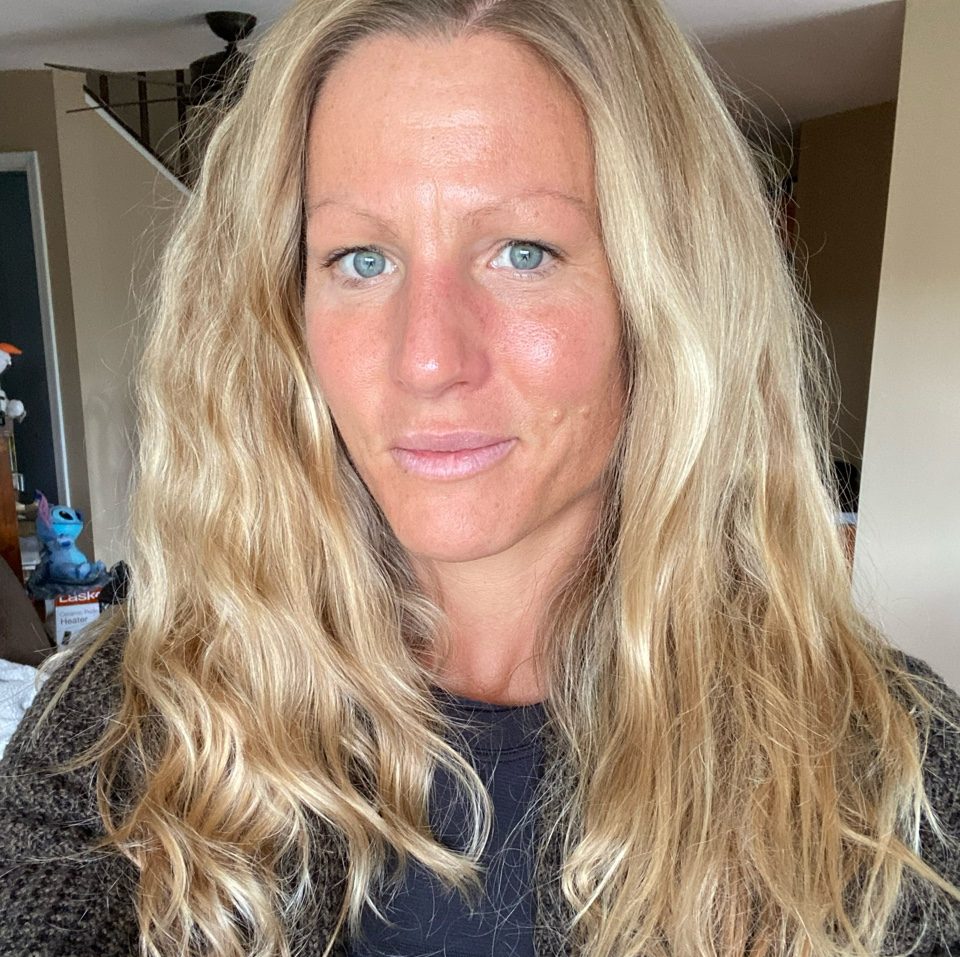
Maybe it was too soon. Maybe I didn’t have enough time in sobriety and real therapy — as in, the kind where you’re not sitting there in a fog of denial, willfully spewing lies — before I decided to go back to school to become an addictions therapist.
Or, maybe I hadn’t “worked a program” hard enough in the time I did have, and I had no business thinking I could act like a normal person — much less a competent professional — while starting from scratch in an emotional occupation and getting a bottom-rung job in a high-stress setting.
These thoughts occurred to me this week as I entered my ninth month as a rookie drug and alcohol counselor, feeling out of my depth with no life raft in sight.
^This was basically the scene early Friday morning as I sat in my dimly lit office hunched over a stack of confusing paperwork, hurriedly trying to tie up loose ends for one client before another one arrived for a 6AM session.
It had been an especially rough week, adjusting to the start of my third and final year of grad school, on top of an increasingly chaotic caseload at the clinic. Any positive vibes from my wee-hours commute, when I listened to music and talked myself up, vanished the second I entered the building. I felt my jaw clench, my shoulders tense, and my stomach start to churn.
The head nurse stopped at my door Friday, moments after I arrived, just peeking in to ask, “Are you doing all right?” And the dam broke. 😭 Tears turned to sobs when she came over, put her hand on my shoulder and said, “It’s OK This work is hard. You’re doing a good job.”
Her words entered my ear and seeped right into my bloodstream, as potent and powerful as any drug. More than four years after my last sip of alcohol, I can still get drunk on others’ approval.
I didn’t realize just how thirsty I’ve been for that intoxicating rush.
Feelings of incompetence are a huge trigger for my Type-A inner child. At 45 years old, I’m still the good little girl who thought it was her job to dazzle the adults with exceptional smarts, style, artistry and athleticism, and who was hellbent on proving her competence in every task she undertook.
Even after all this time, it seems my brain is still working that same self-worth equation every single day: DO good = AM good, and anything less is a big fat failure. Such a fixed mindset is, of course, fertile ground for addiction, and I wonder how I ever thought a highly sensitive, emotional alcoholic, who still clearly yearns for external validation to make me feel whole, could ever make it in a field where “success” requires being strong for others.
The whole point of a helping profession is to HELP PEOPLE, and for anyone raised on rugged individualism believing they can handle shit all on their own, that’s a completely foreign playing field.
I can’t pretend that I understand all the rules of this counseling “game” with less than a year of experience. My straight A’s in school don’t mean squat. However, I can see that gauging one’s own competence based on another person’s reactions/choices/outcomes is a prescription for never-ending inner turmoil.
Funny…that’s basically lesson #1 for folks in recovery. Actually, it’s the whole point of the Serenity Prayer!
ACCEPTANCE OF WHAT I CANNOT CHANGE: No matter how “good” you are as a therapist, you ultimately can’t change what’s in another human being’s heart/mind. People are complicated, unwieldy, unpredictable, uncontrollable, and what moves them to change, or keeps them stuck, can be a maddening mystery. What moves them to show up, or go dark, or flat-out tell you to f*ck off….the world may never know.
COURAGE TO CHANGE WHAT I CAN: No matter what other people say/do, it’s your responsibility to stay open and willing to learn/grow and to keep working on yourself, which involves getting outside of yourself. It’s your responsibility to keep seeking knowledge, honing your skills and practicing your craft, so you feel equipped to ask clients direct questions, challenge their negative patterns of thinking and behaving, hold them accountable for their actions, provide them with tools and connect them with resources, which they can choose to use or not use. And it’s imperative that you keep showing up and trying, even when you want to give up, freak out, run and hide — or when it feels like you’re about to drown.
WISDOM TO KNOW THE DIFFERENCE: What is, and what isn’t, within your control? What is, and what isn’t, your job? Written out like that, the contrast seems pretty clear. Take care of your own business so you can bring your best self to your relationships, and everything else is out of your hands.
Intellectually, the concept of serenity seems so easy to understand. But if you’ve tried to live sober in this f*cked-up world for any length of time, you know: Nothing seems quite so elusive as inner peace. If proving competence means achieving balance, I’m not sure that struggle ever ends.
Someone in the counseling field once told me, “This job won’t keep you sober,” and at first, I brushed off their advice. I thought that constantly being reminded of how miserable active addiction can be would “scare me straight,” or make me count my blessings. But in time, I realized they were right: It’s the stress, the conflict, the chaos, the confusion, the emotion — the fact I never leave work feeling like I “did good” — that jacks up the nervous system and wears down the resistances. It can get to the point where you’re so fried you start looking for any way to just make it stop.
That’s the danger zone I was in when leaving work for the holiday weekend. The familiar refrain of “I’m not good enough” played in my head, a sound I drowned in alcohol for nearly half my life. Booze killed the part of me that gave a f*ck; it was the “easy button” all humans crave when life gets really hard and we’re pinned in a painful spot.
In that place, recovering addicts are taught to turn outward, or upward, open up and tap in. To step backward, take stock, get our priorities straight, our “side of the street” cleaned up, and our spiritual house in order. Whenever I’ve strayed from the path I learned in “the program,” I get into trouble. If I give a f*ck about my quality of life, in and out of work, I’d better get my recovery back on track!
“God keeps sending you the same lessons until you learn them,” is one of the more meaningful sayings I ever heard in a 12-step meeting, and I think that’s what my current struggle is all about. Shifting from a childish fixed mindset into a daily practice of maturity, growth and service to others must involve some faith, some reliance on a power greater than yourself.
Amazing how the most basic principles can be the most difficult to grasp! Living well is less about how “good” you do and more about how much you give. And true “competence” in any meaningful pursuit only comes when you learn to let go.

 Jen Wielgus Journalism
Thanks, Jen. “It never ends!” was a loud refrain once used by the late comedian, Sam Kinison, in one of his more outrageous skits. Some day when you’re in the mood for a pants wetting laugh, give it a view. This is the second time this week that the topic of ‘Balance’ has appeared in my consciousness. My experience has been that throughout my sober life I’ve tried to maintain a balance of time spent on Working, (providing FOR family), time spent actually WITH family, Recovery, (including meetings, 12th step work) and Personal time. My thinking was that upon retirement, it would all be different and less challenging. To a small degree, it has been somewhat less challenging mostly because of a guaranteed income upon retirement. Actually, less stressful rather than less challenging. But the balancing act continues. What I have found over the years of this ever shifting allocation of time and attention to these commitments to obligations and responsibilities is that the more closely aligned with my Center/God/Higher Power, raison d’etre, my core, my innermost self, or whatever name you use, the less I worry, and the more I believe that all is well. Despite my fear, all is well and will be well. And that I am loved. As I am. Flawed, unsure, afraid and confused, yet loved. As I love all of those around me who are flawed, unsure, afraid and confused. That most intimate of intimate relationships is the hub that turns the wheel for me. This struggle is a part of the equation to “emotional balance”.
Also, recently, I stumbled upon an old poem that I first read in early recovery that so impressed me back then. The “Desiderata” by Max Ehrmann. I was surprised to find out that it had been around since the ’20s, had been displayed on posters and greeting cards and such all through the ’60s and ’70s but never caught my eye. The poem reminds me to “nurture strength of spirit” because I will need it. I’ve tried to take that seriously by fighting diligently for the quiet time I need to nurture my spirit as equally as I would fight for any of my other basic needs. This is, for me, another element in the equation to “emotional balance.
For me the struggle for balance continues and the “reward”, so to speak, has been another 24 hours and a modicum of respect and love for myself for having tried. And sometimes I don’t “feel” worthy, but in my heart I “know” I am.
Like Sam said, “It never ends!!!” Peace.
LikeLike