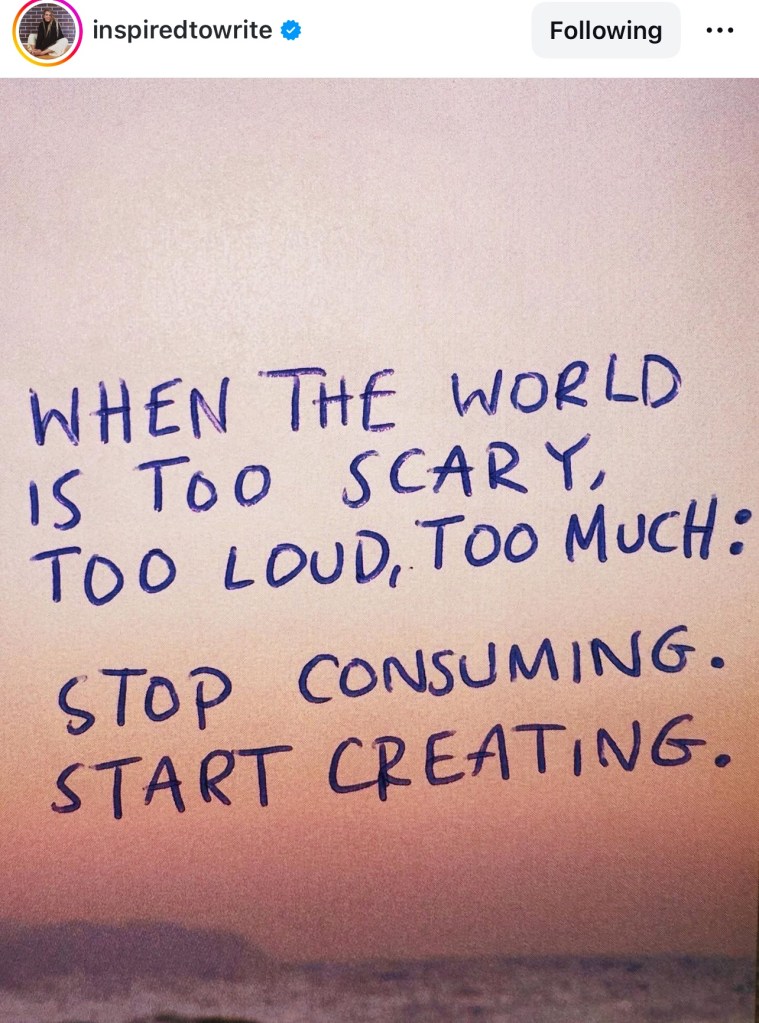
The first thing I stopped consuming was social media content — outside of Instagram and Threads, which I’ve unapologetically curated into echo chambers full of pro-recovery/therapy profiles and fellow blue hearts. I went and deactivated Twitter, which should’ve been done 10 years ago, but I digress…
The first thing I started creating (before this post) was a plan to GTFO of Pennsylvania. I mean, not permanently, though my hubby did come downstairs early on the morning after, talking about Canada and going to live on a lake (he’s a keeper, and the only thing keeping me from going full 4B 😉). I asked if Vermont would be a good compromise.
But what I actually did was book a round-trip flight to Chicago for the upcoming holiday. I haven’t been home for Thanksgiving since I lived at home, which would’ve been prior to my Northwestern graduation in…shoot, 1999? While I made a life for myself out in the world, after much wandering in the wilderness, my first instinct in times of crisis has always been to get my ass immediately back to my parents’ house.
All you folks in 12-step programs might recognize this as “pulling a geographic.” And yeah, guilty as charged! Running away is still my go-to self-soothing strategy, even though the lesson of “Wherever you go, there you are” has been hammered into my brain by the school of hard knocks over 20 years’ time.
The difference now, at 64 months sober, is awareness. And clarity. The understanding that each action/reaction is a choice, with consequences, and I am fully responsible for the choices I make and the consequences that come. Whether I weigh pro vs. con or act impulsively, whether I consciously break cycles or continue dysfunctional patterns, obey the commands of old programming or resist that pull and do something different — that is up to me. Each moment of my life presents a new opportunity, and sobriety equips me, empowers me, to seize it.
That is the one thing bringing me comfort amid this post-election devastation.
Well, that, and love, which also endures. I’m so freaking fortunate to have a husband who has loved me as I am through a hurricane of changes over the past five years, and a mature marriage in which we can be kindred spirits and respect each other’s individuality.
It’s hard to “leave” my hubby for Thanksgiving, but the choice to visit my family of origin, whom I only see once or twice a year, in the blue state where I was born and raised, where I know that my value system and alcohol-free lifestyle will be warmly embraced (if not always fully understood)…that seems like a bit of a no-brainer.
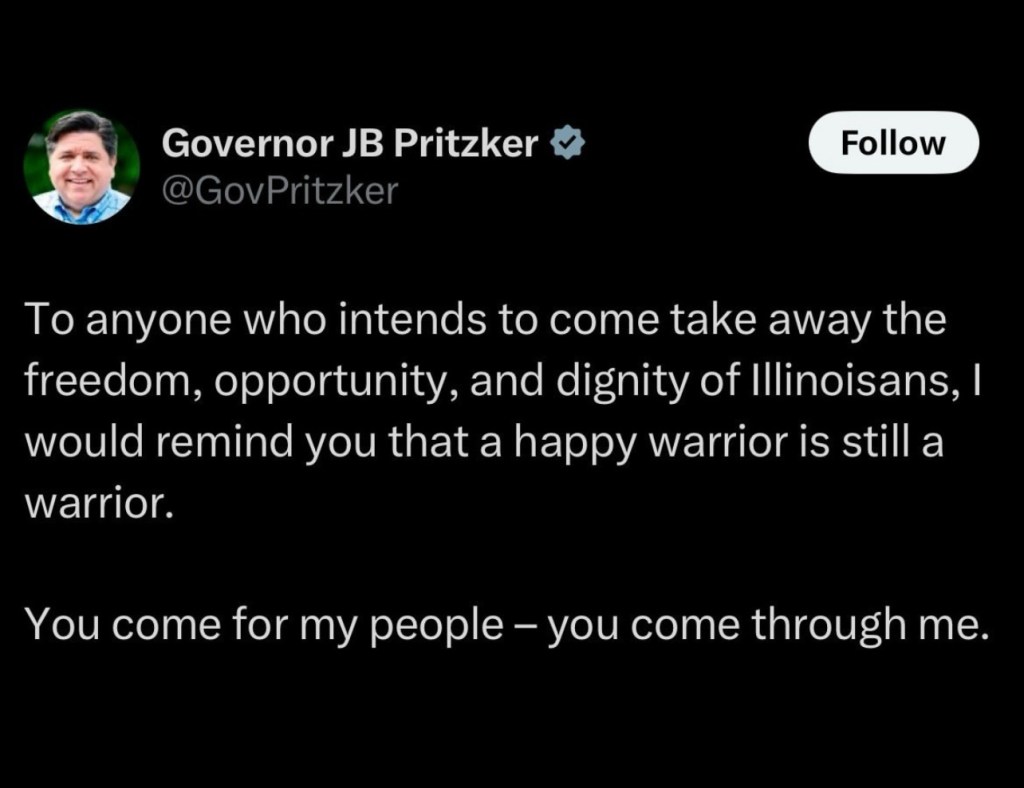
Growing up is not a passive process, in my experience; it requires the full operation of one’s brain. Yeah, that sucks, because it means we have to face reality, behave intentionally, accept accountability — and who really wants to do that? Growing up means we can’t continue to coast along on autopilot or go around telling people “that’s just the way I am,” ignoring our issues and numbing, stuffing or denying big feelings when we encounter hard things. I mean, we surely can, if we don’t care about maturing, evolving, or contributing to our world in a truly meaningful, productive way.
That is a choice. It’s a valid one, as I said before, and I understand it, even if I no longer accept it as the way I’m meant to live.
It’s a choice I made at age 19, when I started self-medicating my way through the gut-wrenching transition between adolescence and adulthood. My path has been well-documented in this space: First, I developed an eating disorder, trying to prove my worth to the world by shrinking my body via extreme calorie restriction and obsessive overexercising. Then, I developed an alcohol addiction, believing I’d finally found the one thing that could slow down my anxiety and shut up my inner critic, and deciding it was easier to just check out than try to keep up.
Here’s a flow chart to illustrate the process: Performance-based self-worth ➡️ perfectionistic obsession ➡️ habitual self-medication ➡️ diminished capacity ➡️ all sorts of poor decisions, compromising positions and dangerous situations ➡️ “rock bottom,” point of reckoning, time to 💩 or get off the 🚽.
Until I reached the end and chose the latter, I never wondered, why? To whose wagon had I been hitching my star? When I adopted black-and-white perfectionism as my blueprint for life, who was I trying to impress? What messages had I received about what it means to be a woman, a human, a success, from my family and my environment? How had I been conditioned to believe and behave by the generations of white, heterosexual, Christian, middle-class women who raised me, the mostly white, middle-class community I was raised in, and the mostly white, male-dominated media I consumed throughout my life?
It’s a real gut punch to realize that you bought in — all in — to the systems constructed to control you. And you have been blindly following along, no questions asked.

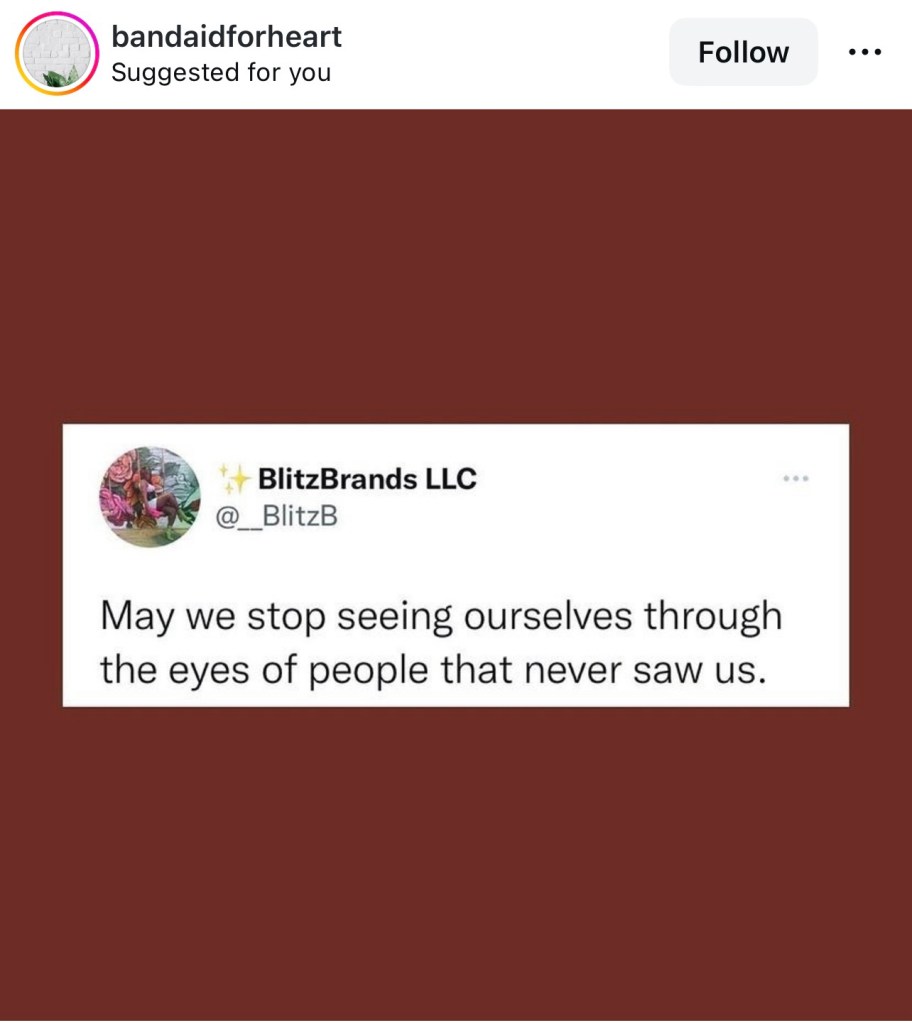

As a young’un, I never would’ve thought I “bought in” to anything, much less patriarchal, capitalistic norms set up to deny me autonomy and exploit/profit off of my dreams, fears, strengths and sensitivities. Most of my female role models were well-educated, fiercely independent career women, several of whom were also childfree. I fancied myself a “divergent” — “a loner, Dottie, a rebel” — walking “the road less traveled” guided by my own internal compass, not caring what everyone else thought. I didn’t grow up consciously believing I needed a man or had to get married or was expected have children. And still, looking back, underneath it all, my ideals, goals, and metrics for success all were formed and calibrated according to the male gaze.
Obsessing over my weight was just one aspect of the resulting dysfunction. I mean, I never had any boundaries or dating standards, and anyone who showed me interest was deemed instantly important — someone to please, no matter what I would’ve preferred, and damned if I ever stopped to ponder what that was. I entertained far, far too many sexist comments and inappropriate advances over my years in sports journalism, and the deeper I got into alcoholism…well, I’m sure you get the picture.
This is all incredibly sad to admit, but perhaps worst of all was my view of other women. I saw them as competition, as rivals, and called myself a (cringe) “guy’s girl.” I see now that I was too anxious, insecure, immature (and often drunk) to see the damage this mentality can do. When we strike that “patriarchal bargain” and adopt that scarcity mindset, we step onto a lonely hamster wheel where no amount of effort is ever enough and the “payoff” amounts to table scraps.
It’s been quite a revelation, the idea that I can choose to step off. Knowing better enables me to do better, and this is what it means for addicts to make a “living amends.”
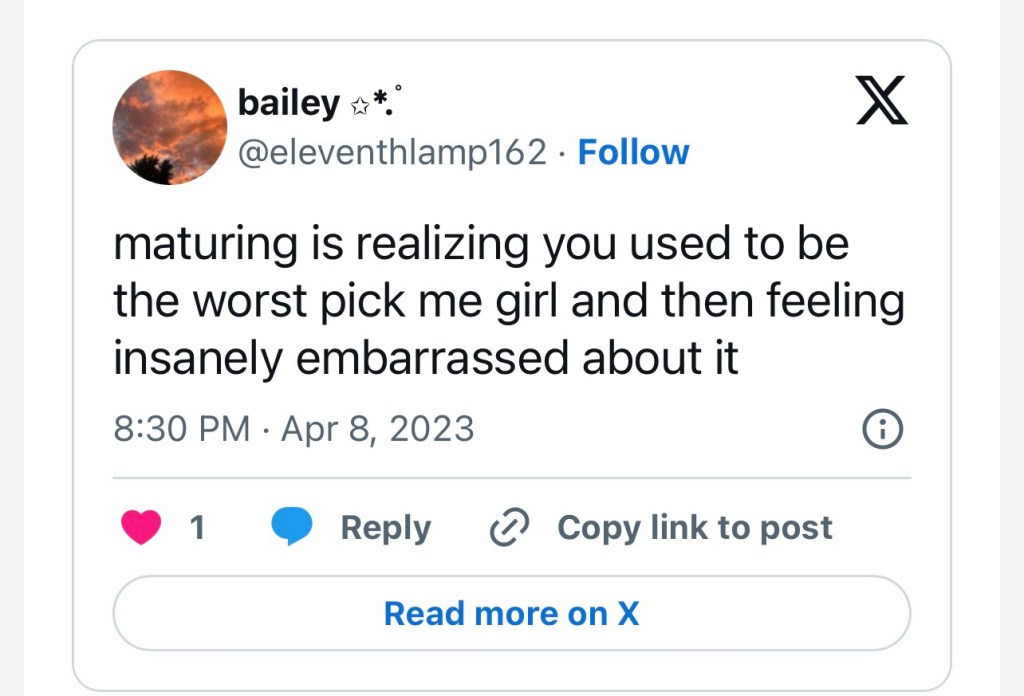
It’s a derogation being thrown around on social media in the wake of the election, and I get it, but I can’t not feel some compassion for the “pick me girls” of the world. I mean, c’mon, little girls have been socialized for ages that their main role on Earth is to people-please — our parents, our teachers, our coaches, our elders, potential partners, complete strangers….Have you seen the movie “Woman of the Hour”? 😬 No one warned us that all these little “nice girl” pleasantries could get us killed!
Maybe things are changing, but I was born in 1978, and I absolutely had those “pick me” toxins flowing through my blood.
I didn’t begin flushing the system until age 41, after quitting drinking and going for my master’s in counseling and having my mind blown by my school’s social justice curriculum. I needed every ounce of extra brain capacity I gained by getting sober to unpack my unearned white privilege, identify my unconscious biases, and examine all the ways that social systems had infiltrated my psyche and influenced my behavior. At 46, I’m still in the process of purging shit that no longer serves me today. By no means am I cleaned out, but at least I am awake.
And to borrow Kamala’s slogan, I am not going back.
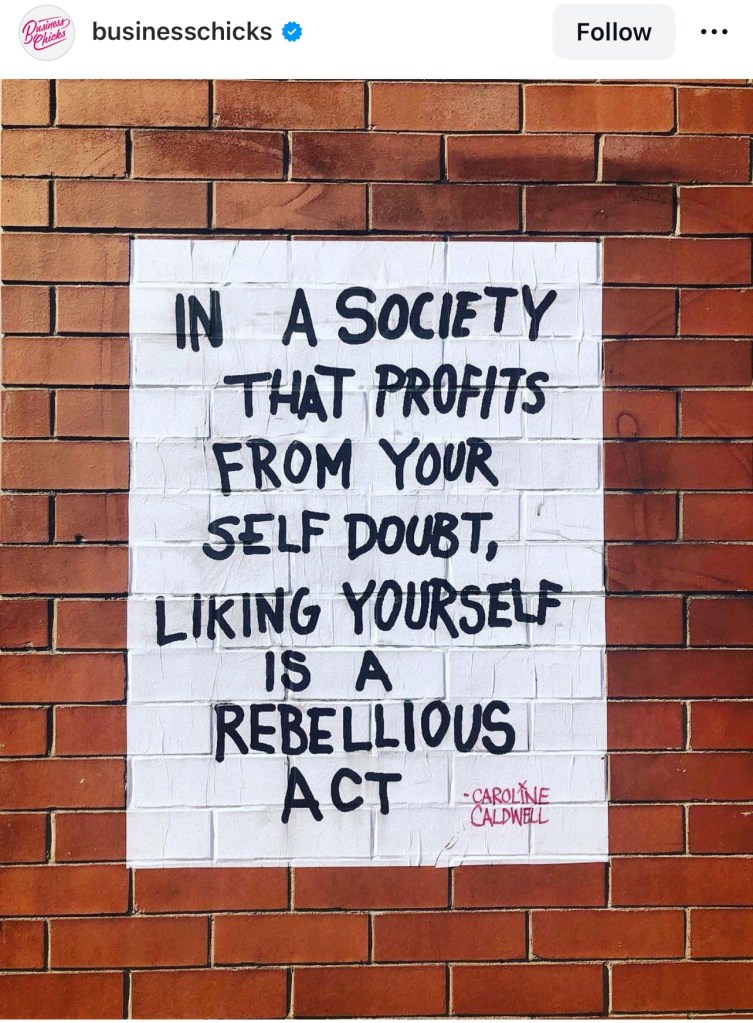
I speak from a place of pain in this post, but also from a place of privilege. I’m white, cis/het, and perimenopausal, with a supportive partner and no kids or concerns about pregnancy. My personal resistance to antiquated, ignorant attitudes and vicious, harmful cycles only goes so far.
That’s why it’s so good be sober and focused on something outside myself. Recovery has made me useful, and capable, and wise. I know who I am and what I value. I’ve learned from my mistakes. I’m finally thinking/acting like a grownup and fully committed to the process of change, for myself and my therapy clients. I know the difference between what I can and can’t control, and I feel empowered to serve a greater purpose. By loving and supporting my clients, I can create tiny ripples of hope in this sea of…oh God, who even knows what?
In the book “Man’s Search for Meaning,” Viktor Frankl writes about enduring the horrors of a Nazi death camp during World War II: “Everything can be taken from a man but one thing: the last of the human freedoms — to choose one’s attitude in any given set of circumstances, to choose one’s own way.”
Frankl called this concept “spiritual freedom.” I call it a tool of resistance.
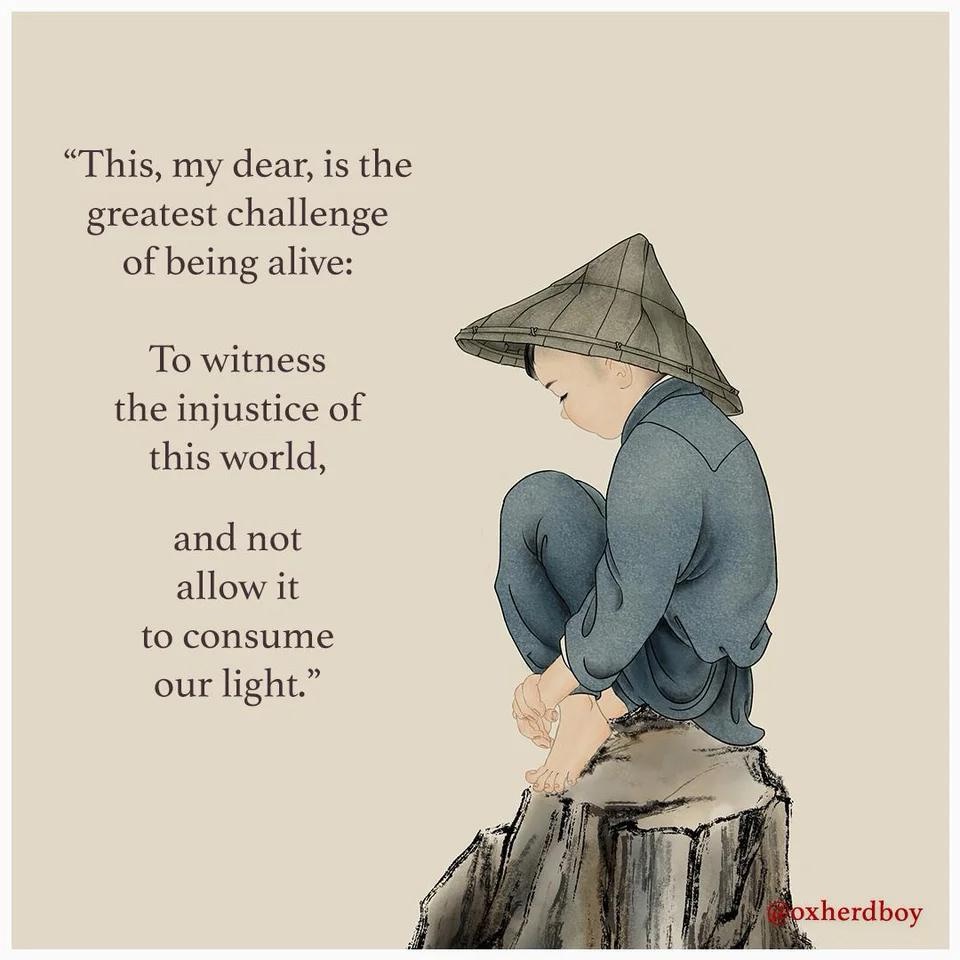
There’s a running joke in my family that “sometimes you don’t get picked,” which I think originated as something my little niece said to my sister when she got left out of a family Cubs outing because there weren’t enough tickets to go around. (I feel like I could use this joke about Thanksgiving, because apparently my sisters and the grandkids are going elsewhere, so all my parents get is me. 😆)
Out of the mouths of babes — oh, all the precious little girls out there struggling to understand the world they live in right now! 😭😭😭 — comes a hard truth we all learn, on a micro and macro level, throughout the course of our lives: Striving to “get picked” only sets you up for bitter disappointment. Don’t believe it? F^ck around and find out!
Snapping into therapist mode, I ask: What would happen if we stopped making “getting picked” a priority? What would it be like to release our attachment to their opinions, preferences, standards and expectations, and opted to disregard their rules for the way things “should” be — after all, as the wonderful Anna Przy says, “everything is made up.” What could we accomplish if we stopped looking outward for validation and started looking inward for direction, if we figured out who we really are underneath everything the world has made of us, and what we want apart from anything they deem desirable?
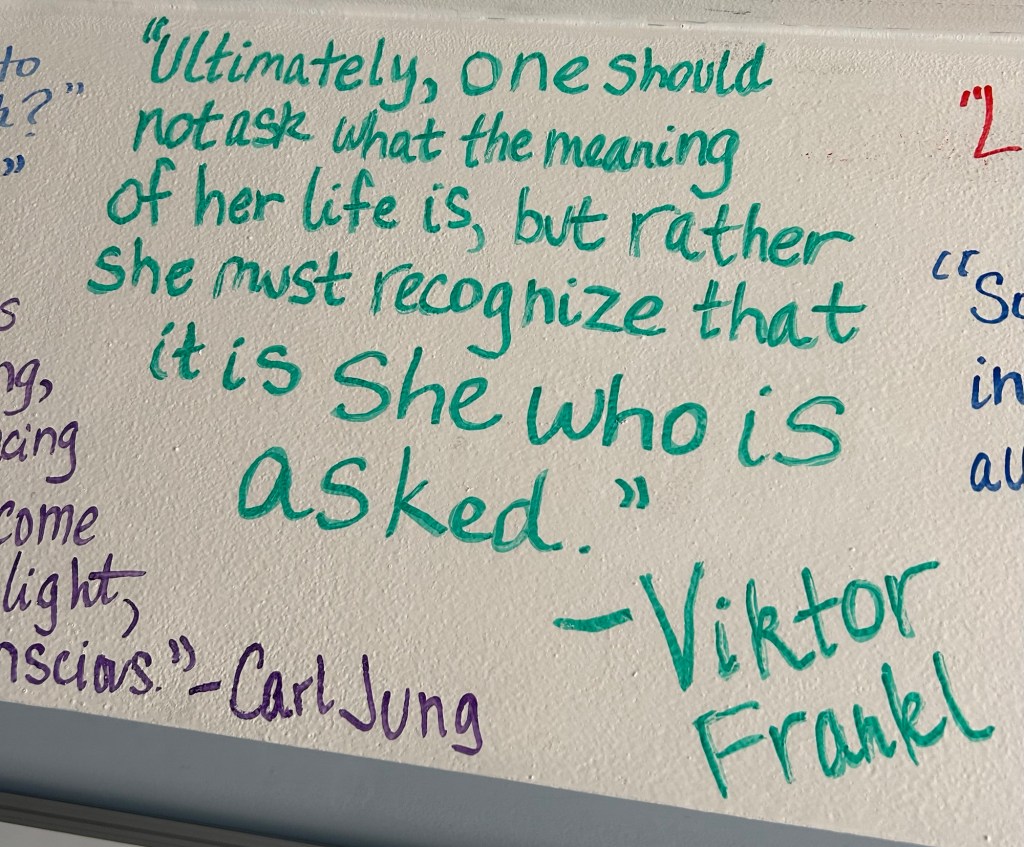
Sometimes you don’t get picked…and therein lies your freedom. The great existential dilemma rears its head yet again. What meaning can be found in this suffering, and in the midst of darkness, how can you protect your light?
The answers aren’t out there, now or ever. Moment by moment, we each get to make our own picks. ⬇️

 Jen Wielgus Journalism